The Amarnath Yatra 2026 is set to be one of the most closely watched pilgrimages of the year, with the Shri Amarnathji Shrine Board (SASB) confirming that this year’s sacred journey to the holy ice Shivling will run from July 3, 2026, to August 28, 2026 — a total of 57 days. Every year, lakhs of devotees undertake this arduous trek through the Kashmir Himalayas to the Holy Cave Shrine, located at an altitude of nearly 3,888 metres, where a naturally forming ice lingam is worshipped as Lord Shiva. If you are planning to undertake the Amarnath Yatra 2026 registration, this guide gives you accurate, verified information on dates, documents, routes, and this year’s most significant update — the suspension of helicopter services for pilgrims.
This article covers everything related to the Amarnath Yatra 2026, including the step-by-step online and offline registration process, the mandatory Compulsory Health Certificate (CHC), the list of authorised medical hospitals/doctors, the two pilgrimage routes — Baltal and Pahalgam, the RFID card system, and the officially confirmed “No Flying Zone” declaration that affects helicopter travel this season. Whether you’re a first-time pilgrim or a seasoned Yatri, this guide reflects the latest 2026 data directly sourced from SASB’s official notifications, so you get accurate details rather than outdated or duplicate information published elsewhere.
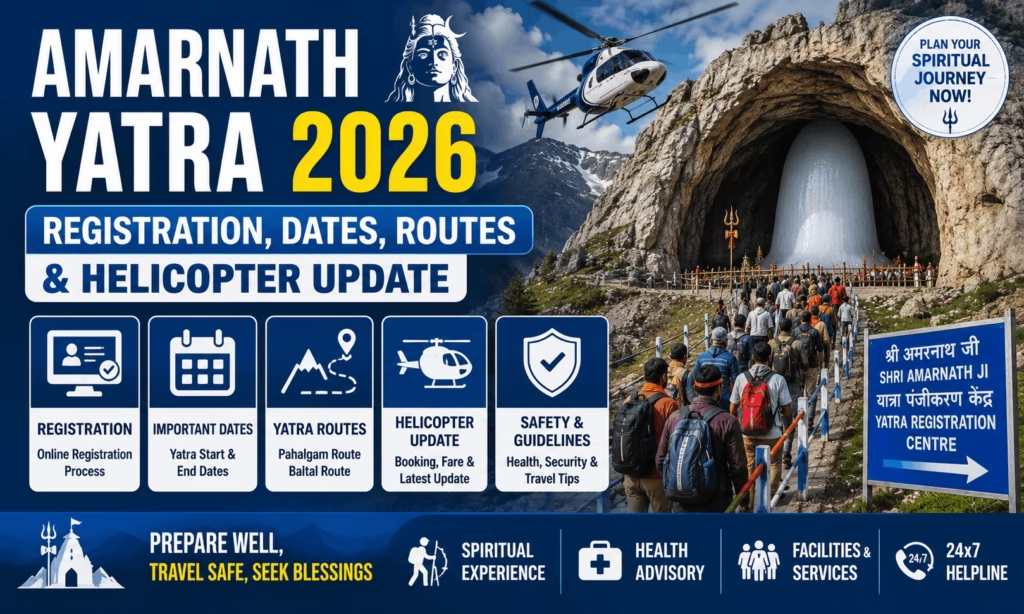
Amarnath Yatra 2026 Key Dates and Highlights
| Yatra Name | Shri Amarnathji Yatra (SANJY) 2026 |
| Managing Authority | Shri Amarnathji Shrine Board (SASB) |
| Yatra Start Date | July 3, 2026 |
| Yatra End Date | August 28, 2026 |
| Total Duration | 57 days |
| Advance Registration Opens | April 15, 2026 |
| Registration Fee | ₹150 per pilgrim |
| Compulsory Health Certificate (CHC) Validity | Must be issued on or after April 8, 2026 |
| Eligible Age Limit | 13 to 70 years |
| Pregnancy Restriction | Women more than 6 weeks pregnant not permitted |
| Registration Modes | Online (jksasb.nic.in) and 550+ designated bank branches |
| Designated Banks | SBI, PNB, J&K Bank, Yes Bank |
| Mandatory Identity Document | RFID Card (collected after eKYC biometric verification) |
| Routes Available | Baltal Route (~14 km) and Pahalgam Route (~46–48 km) |
| Helicopter Service (2026) | Suspended — declared “No Flying Zone” from July 1, 2026 |
| Notification Reference | Government Order No. 321-HOME of 2026, dated June 1, 2026 |
| Official Website | jksasb.nic.in |
Amarnath Yatra 2026 Registration Process
The Amarnath Yatra 2026 registration is mandatory for every pilgrim, and unregistered individuals are turned back at multiple checkpoints along the route. Registration is managed entirely by SASB and can be completed either online or offline.
Online Registration Process
- Visit the official SASB website: jksasb.nic.in
- Navigate to the Advance Registration section for Yatra 2026.
- Fill in your personal details — name, date of birth, contact information, and address — as per your government ID.
- Upload the required documents, including your Compulsory Health Certificate (CHC) and a passport-size photograph.
- Select your preferred route (Baltal or Pahalgam) and travel date.
- Pay the registration fee of ₹150 online.
- Download and print your Yatra Permit — carry multiple copies, as it will be checked at several points along the route.
Offline Registration Process
Pilgrims can also register in person at any of the 550+ designated bank branches across India, including select branches of State Bank of India (SBI), Punjab National Bank (PNB), Jammu & Kashmir Bank, and Yes Bank. The step-by-step procedure for bank-branch registration and the state-wise list of designated branches are both published on the official SASB website.
Compulsory Health Certificate (CHC): Mandatory Document for Amarnath Yatra 2026
The CHC is the single most important document required for Yatra registration, given the physically demanding, high-altitude nature of the trek:
- The CHC must be issued on or after April 8, 2026 — certificates issued before this date are not valid for Yatra 2026.
- It must be issued by a doctor or hospital listed on SASB’s official State/UT-wise List of Authorised Doctors/Institutions, available on jksasb.nic.in.
- The certificate must carry the applicant’s photograph, duly attested by the authorised doctor.
- For online submission, the CHC must be uploaded as a scanned PDF, typically within a 1 MB file size limit.
- The CHC requirement applies to all pilgrims, including those who previously intended to travel by helicopter.
Pilgrims are strongly advised to undergo a complete medical check-up before travelling, given the high-altitude conditions along both routes.
Eligibility Criteria for Amarnath Yatra 2026
- Applicants must be between 13 and 70 years of age as on the date of the Yatra.
- Women who are more than six weeks pregnant are not permitted to undertake the Yatra.
- A valid Compulsory Health Certificate (CHC) from an SASB-authorised doctor or institution is mandatory.
- The Yatra is open to Indian nationals, NRIs, and foreign nationals, though NRIs and foreign nationals follow a separate application procedure, with a dedicated Application Form for Group and NRI/Ex-India Pilgrims/Foreign Nationals available on the SASB website.
- There is no restriction based on religion — the Yatra is open to all eligible individuals.
RFID Card: Mandatory Safety Requirement for 2026
Every registered pilgrim for Amarnath Yatra 2026 must collect a mandatory RFID (Radio Frequency Identification) card from designated centres in Jammu or Srinagar before starting the trek. Key points to note:
- The RFID card is collected after registration and eKYC biometric verification, and is separate from the Yatra Permit.
- Carry your Aadhaar details while collecting the RFID card.
- The RFID tag must be worn around the neck at all times during the Yatra for safety and tracking purposes.
- No pilgrim will be allowed to cross the gate points at Domail (Baltal route) or Chandanwari (Pahalgam route) without a valid RFID card.
- The system enables real-time tracking of pilgrims to support emergency response along the route.
Amarnath Yatra Routes 2026: Baltal vs Pahalgam
There are two officially approved routes to reach the Holy Cave Shrine, and pilgrims must choose based on their fitness level and available time:
- Baltal Route: The shorter route, approximately 14 km one-way, starting near Sonamarg. This route is steep and physically demanding but can typically be completed in 1–2 days, making it popular among fit, time-constrained pilgrims.
- Pahalgam Route: The traditional route, spanning roughly 46–48 km, starting from Pahalgam in Anantnag district and passing through Chandanwari, Sheshnag, and Panchtarni before reaching the cave. This route has a gentler gradient but takes 3–5 days, making it more suitable for families and first-time pilgrims.
Both routes converge at Panchtarni, from where the final stretch of approximately 6 km to the Holy Cave must be completed on foot, or with the assistance of ponies or palkis.
Helicopter Service Update for Amarnath Yatra 2026: Important Notice
One of the most significant updates for Amarnath Yatra 2026 concerns helicopter travel. As per an official SASB notice, the Competent Authority has, via Government Order No. 321-HOME of 2026, dated June 1, 2026, declared all routes of the Yatra — both the Pahalgam and Baltal axes — as a “No Flying Zone” from July 1, 2026, until the completion of the Yatra.
As a result, helicopter services for pilgrim travel are not available during Amarnath Yatra 2026. Pilgrims planning to reach the Holy Cave Shrine this season must do so entirely on foot, or with the assistance of ponies and palkis, along either the Baltal or Pahalgam route. This is an official, government-notified restriction and pilgrims — especially elderly travellers or those who had planned around helicopter access — are strongly advised to plan their itinerary accordingly, choose the gentler Pahalgam route if needed, and factor in additional trekking days. Given that this restriction stems from an official government order, pilgrims should regularly check jksasb.nic.in for any further updates before finalising travel plans.
Medical Hospitals and Health Facilities Along the Route
Given the high-altitude trekking conditions, SASB coordinates with health authorities to ensure medical support is available at key points along both routes, including base camps at Baltal, Chandanwari, Sheshnag, and Panchtarni. Pilgrims are advised to:
- Carry essential personal medicines and stay hydrated throughout the journey.
- Report any symptoms of high-altitude illness immediately to medical personnel stationed along the route.
- Ensure their Compulsory Health Certificate reflects an accurate and current health assessment before departure.
- Avoid alcohol, caffeinated drinks, and smoking during the Yatra, as advised in SASB’s official Do’s and Don’ts.
Documents Required for Amarnath Yatra 2026
- Compulsory Health Certificate (CHC), issued on or after April 8, 2026
- Valid government photo ID (Aadhaar, Voter ID, Passport, or Driving License)
- Passport-size photographs
- Yatra Registration Permit (downloaded after successful registration)
- RFID Card (collected separately after eKYC verification)
Amarnath Yatra 2026 Links
| Official Website | jksasb.nic.in |
| Advance Registration Guidelines | Available under “Step by Step Procedure Through Designated Bank Branches” on the SASB website |
| CHC Forms (English & Hindi) | Available for download on jksasb.nic.in |
| List of Authorised Doctors/Institutions for CHC | jksasb.nic.in/ListofAuthorizedDoctorsInstitutions2026.html |
| State-Wise List of Designated Bank Branches | Available on the SASB official website |
| NRI/Foreign National Application Form | Available under Yatra 2026 Forms section |
| Live Weather Updates for Yatra Route | Provided via IMD’s dedicated Amarnath portal, linked from jksasb.nic.in |
| Helpdesk/Query Support | Email support link available on jksasb.nic.in for Yatra 2026 queries |
| Home Page | https://emrsbahraichup.in/ |
Do’s and Don’ts for Amarnath Yatra 2026 Pilgrims
- Do carry sufficient woolen clothing, as temperatures can drop below 5°C.
- Do carry an umbrella, wind cheater, raincoat, and waterproof shoes, as weather in the Yatra area is highly unpredictable.
- Do wear trekking shoes with laces — slippers are strictly discouraged due to steep, uneven terrain.
- Don’t attempt shortcuts on the route, as this can be dangerous.
- Don’t ignore symptoms of high-altitude illness — report them to medical staff immediately.
- Use of plastics is strictly banned in the Yatra area and is punishable under law.
The Amarnath Yatra 2026 brings together deep spiritual significance and serious logistical planning, with SASB confirming the Yatra dates as July 3 to August 28, 2026. This year’s most important development for pilgrims is the official suspension of helicopter services, making thorough preparation for the Baltal or Pahalgam trekking routes essential for anyone planning to undertake the journey. With mandatory requirements like the Compulsory Health Certificate and RFID card, along with strict registration timelines, pilgrims are strongly advised to complete their Amarnath Yatra 2026 registration well in advance through jksasb.nic.in and stay updated on the latest official notifications before beginning their pilgrimage.
FAQs
The Amarnath Yatra 2026 will commence on July 3, 2026, and conclude on August 28, 2026, spanning a total of 57 days, as officially confirmed by SASB.
Advance registration for Amarnath Yatra 2026 began on April 15, 2026, and can be completed online via jksasb.nic.in or offline at designated bank branches.
No. SASB has officially declared all Yatra routes a “No Flying Zone” from July 1, 2026, until the Yatra concludes. Pilgrims must travel on foot or by pony/palki this season.
The CHC is a mandatory medical fitness certificate that must be issued by an SASB-authorised doctor on or after April 8, 2026, confirming a pilgrim’s fitness for the high-altitude trek.
Pilgrims must be between 13 and 70 years of age; women who are more than six weeks pregnant are not permitted to undertake the Yatra.
The Pahalgam route (46–48 km) has a gentler gradient but takes 3–5 days, making it suitable for families and first-timers. The Baltal route (~14 km) is shorter but much steeper, completed in 1–2 days.
Yes, the RFID card is mandatory for all registered pilgrims and must be collected from designated centres in Jammu or Srinagar after eKYC verification. No pilgrim can cross gate points without it.
Yes, NRIs and foreign nationals can register through a separate application process, using the dedicated Group/NRI/Foreign National Application Form available on jksasb.nic.in.