The PM Surya Ghar Muft Bijli Yojana 2026 continues to be India’s largest residential rooftop solar initiative, offering eligible households a central subsidy of up to ₹78,000 along with roughly 300 units of free electricity every month. Launched by the Government of India on 13 February 2024 under the Ministry of New and Renewable Energy (MNRE), the scheme is being implemented through a single national portal, pmsuryaghar.gov.in, in coordination with state DISCOMs. As of mid-2026, the portal has moved past its earlier glitches, and applicants can now track every stage of their application in real time, from DISCOM approval to net metering and final subsidy disbursement.
This updated 2026 guide covers everything homeowners need before starting a fresh application: the current subsidy slabs, step-by-step PM Surya Ghar apply online process, eligibility criteria, required documents, latest disbursement figures, state top-up subsidies, and the PM Surya Ghar status check procedure. Whether you are applying for the first time or checking on a pending application, this article reflects the latest scheme data available for 2026, so you can move forward without relying on outdated or incorrect figures circulating online.
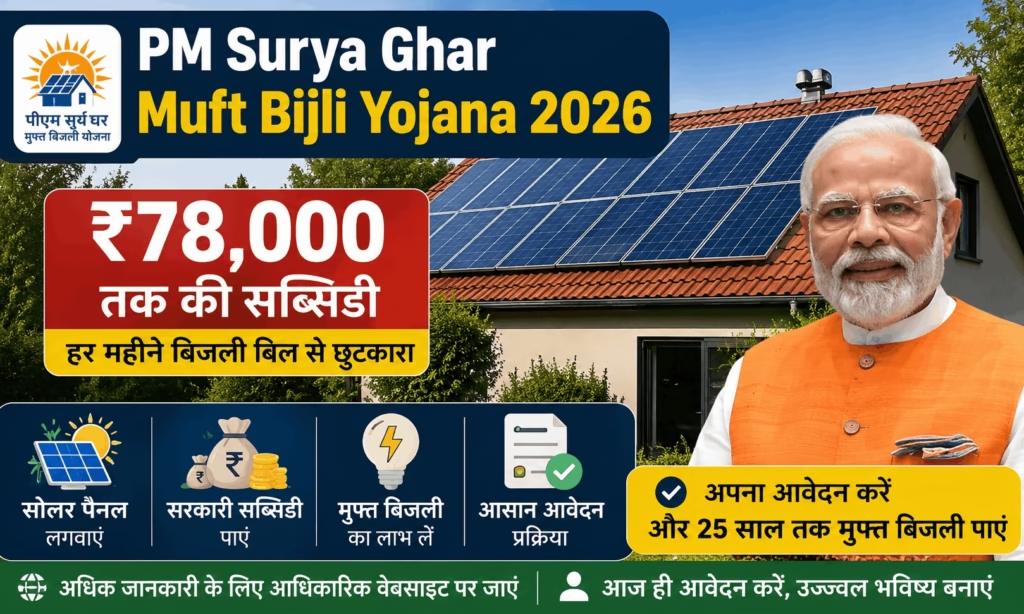
PM Surya Ghar Muft Bijli Yojana 2026 Highlights
| Particulars | Details |
|---|---|
| Scheme Name | PM Surya Ghar: Muft Bijli Yojana |
| Launched On | 13 February 2024 |
| Ministry | Ministry of New and Renewable Energy (MNRE) |
| Official Portal | pmsuryaghar.gov.in |
| Maximum Central Subsidy | ₹78,000 per household |
| Free Electricity | Up to 300 units per month |
| Target | 1 crore households by March 2027 |
| Total Scheme Outlay | ₹75,021 crore |
| Households Benefited (as of May 2026) | Over 32 lakh |
| Subsidy Disbursed So Far | Over ₹14,771 crore |
| Mode of Subsidy Transfer | Direct Benefit Transfer (DBT) to Aadhaar-linked bank account |
| Application Mode | Online |
What Is PM Surya Ghar Muft Bijli Yojana?
PM Surya Ghar Muft Bijli Yojana is a central government scheme designed to bring rooftop solar power within reach of ordinary Indian households. Instead of routing subsidy through DISCOMs, the amount is credited directly into the applicant’s Aadhaar-linked bank account once the rooftop system is installed, inspected, and grid-connected. The scheme replaced the earlier Grid Connected Rooftop Solar Programme Phase II and now operates as a unified national initiative aimed at covering one crore households by March 2027.
Beyond the financial relief of a near-zero electricity bill, the scheme is also positioned as part of India’s clean energy push, with the potential to meaningfully cut household-level carbon emissions over the 25-year working life of an installed system.
PM Surya Ghar Subsidy Slabs 2026
The PM Surya Ghar subsidy structure has stayed unchanged since launch, but disbursement speed has improved considerably through 2026. The subsidy depends entirely on system size, capped at 3 kW:
| System Size | Subsidy Rate | Total Subsidy |
|---|---|---|
| Up to 2 kW | ₹30,000 per kW | Up to ₹60,000 |
| Additional 3rd kW (2–3 kW) | ₹18,000 per kW | Up to ₹18,000 |
| 3 kW and above | — | Maximum ₹78,000 (capped) |
It is important to understand that installing a 5 kW or 10 kW system does not increase the subsidy beyond ₹78,000. The scheme is deliberately structured to support the 1–3 kW residential segment rather than larger installations, so applicants should size their system based on actual household consumption rather than trying to maximise the subsidy amount.
For a typical 3 kW rooftop system, with an installed cost of roughly ₹1.5–1.8 lakh, the central subsidy alone can cover close to half the total investment, before accounting for any additional state-level top-up.
Eligibility Criteria for PM Surya Ghar Yojana 2026
To qualify under PM Surya Ghar registration 2026, applicants must meet the following conditions:
- Must be an Indian citizen.
- Must own a residential property with a roof suitable for solar panel installation (flat or sloped, with adequate space and sunlight exposure).
- Must hold a valid electricity connection under a recognised DISCOM.
- The subsidy can be claimed only once per electricity consumer number; it does not transfer or reset if the property changes ownership.
- The solar panels and inverter used must be listed on the MNRE’s Approved List of Models and Manufacturers (ALMM) to remain eligible for subsidy disbursement.
Documents Required
- Aadhaar Card
- Electricity bill / consumer number
- Bank account passbook or a cancelled cheque (bank account must be Aadhaar-linked)
- Passport-size photograph
- Property ownership proof or rent/lease document, where applicable
- Mobile number registered with the electricity connection
PM Surya Ghar Apply Online
The PM Surya Ghar apply online process runs in two mandatory phases — before installation and after installation. Skipping any step, particularly the net metering application or the DISCOM inspection, can delay subsidy disbursement significantly.
- Registration: Visit the official portal pmsuryaghar.gov.in and click on “Apply for Rooftop Solar.”
- Enter Details: Provide your state, DISCOM, and electricity consumer number exactly as printed on your electricity bill — a single incorrect digit can fail DISCOM verification.
- OTP Verification: Verify using the mobile number registered with your electricity connection to link your application with your DISCOM account.
- Application Submission: Fill in the rooftop solar application form with feasibility details and submit it for DISCOM approval.
- Installer Selection: Once approved, choose a registered vendor from the empanelled installer list, now filterable by state, DISCOM, and district.
- Installation & Net Meter: After installation, apply for the net meter connection through the same portal.
- Inspection & Commissioning: The DISCOM inspects the installation and issues a commissioning certificate upon approval.
- Bank Details Submission: Submit your bank account details and a cancelled cheque after receiving the commissioning certificate.
- Subsidy Disbursement: The subsidy amount is credited directly to your Aadhaar-linked bank account through DBT.
Official Website Links:
| Apply / Registration | https://pmsuryaghar.gov.in |
| Rooftop Solar Portal | https://solarrooftop.pmsuryaghar.gov.in |
| Home Page | https://emrsbahraichup.in/ |
PM Surya Ghar Status Check 2026
Applicants no longer need to wait indefinitely for updates. The PM Surya Ghar status check process has been upgraded through 2026 with the following improvements:
- Real-time status tracking: Every stage — inspection, net meter installation, subsidy disbursement — is now visible on the portal.
- Stable OTP login: Aadhaar-based OTP verification works reliably, with fewer session failures.
- PDF and JPEG uploads: Both document formats are now accepted, with clearer file-size limits displayed.
- District-wise installer filter: Applicants can locate empanelled installers by state, DISCOM, and district.
- Track without login: Simply entering the application/reference number is enough to check status, without logging in.
To check status, visit the official portal, enter your application or reference number, and view whether your application is pending, approved, under inspection, or disbursed.
State-Level Top-Up Subsidies
Several states run additional top-up subsidies on top of the central ₹78,000 subsidy, effectively lowering the net installation cost further for residents of those states. States currently offering additional support include Uttar Pradesh, Rajasthan, Haryana, and Bihar. Applicants in these states should check their respective state renewable energy department portals for current top-up figures, as these vary and are updated periodically.
Scheme Progress: Latest 2026 Data
- Over 32 lakh households have benefited under the scheme as of May 2026.
- More than ₹14,771 crore in subsidies has been disbursed to date.
- Gujarat leads all states with over 5.15 lakh rooftop solar systems installed and 7.41 lakh households benefited.
- Maharashtra (3.92 lakh systems) and Uttar Pradesh (3.26 lakh systems) rank second and third respectively.
- The government has set a target of 35 lakh household installations for the current financial year.
- Collateral-free solar loans are available through public sector banks, including SBI, at competitive interest rates, easing upfront costs for households that do not wish to pay the full installed cost out of pocket.
Benefits of PM Surya Ghar Muft Bijli Yojana
- Up to ₹78,000 direct subsidy credited to your bank account.
- Up to 300 units of free electricity every month for a correctly sized system.
- Long-term savings on electricity bills for 25+ years, the typical working life of a rooftop solar system.
- Option to sell surplus power back to the DISCOM through net metering, generating additional income.
- Reduced dependence on conventional electricity and lower household carbon footprint.
- Collateral-free loan options through public sector banks for households needing financing support.
Common Mistakes to Avoid
- Entering an incorrect electricity consumer number during registration, which fails DISCOM verification.
- Installing panels or inverters that are not listed on the ALMM, making the installation ineligible for subsidy.
- Oversizing the system beyond 3 kW expecting a higher subsidy — the subsidy is capped regardless of system size.
- Missing the net metering application step, which delays final disbursement.
- Assuming the subsidy transfers with property sale — it does not; it is linked permanently to the original consumer number.
FAQs
The maximum central subsidy available is ₹78,000 for a 3 kW or larger rooftop solar system, based on ₹30,000 per kW for the first 2 kW and ₹18,000 per kW for the third kW.
Visit pmsuryaghar.gov.in, register using your state, DISCOM, and electricity consumer number, complete OTP verification, and submit the application form. Installation and net metering follow after DISCOM approval.
You can check your status on the official portal using just your application or reference number — login is not mandatory for status tracking.
Yes, the scheme remains active through FY 2026–27, with the government targeting 1 crore household installations by March 2027.
No, the subsidy can be claimed only once per electricity consumer number, and it does not reset or transfer if the property is sold.
No. The subsidy is capped at ₹78,000 regardless of whether the installed system is 3 kW, 5 kW, or 10 kW.
Yes, several states including Uttar Pradesh, Rajasthan, Haryana, and Bihar offer additional top-up subsidies over and above the central subsidy.
Aadhaar card, electricity bill/consumer number, bank passbook or cancelled cheque, and a passport-size photograph are the primary documents required.
The scheme is implemented by the Ministry of New and Renewable Energy (MNRE) through state DISCOMs and a single national portal.
Once the commissioning certificate is issued and bank details are submitted, the subsidy is typically credited within a few weeks, though timelines can vary by DISCOM.