The PM RAHAT Scheme (Road Accident Victim Hospitalisation and Assured Treatment) is one of the most significant healthcare-safety initiatives launched by the Government of India in 2026. Officially launched by the Prime Minister on February 13, 2026, from Seva Teerth in New Delhi, this scheme guarantees cashless treatment of up to ₹1.5 lakh for every road accident victim, for a maximum period of seven days from the date of the accident. Notified under Section 162 of the Motor Vehicles Act, 1988, the scheme is administered by the Ministry of Road Transport and Highways (MoRTH) and applies to accidents on any category of road — national highway, state highway, or city road — making it one of the widest-reaching road accident cashless treatment schemes in the country.
If you are searching for the latest details on PM RAHAT eligibility, the list of designated hospitals, or the claim process for accident victims, this article provides complete, up-to-date information. We cover how the scheme works through the eDAR (Electronic Detailed Accident Report) and TMS 2.0 (Transaction Management System) platforms, who qualifies for the ₹1.5 lakh cover, how hospitals get reimbursed through the Motor Vehicle Accident Fund (MVAF), and what to do if you face any issue while availing this benefit. This guide reflects the most recent 2026 data, including hospital empanelment figures and grievance redressal details, so you get accurate information rather than outdated or duplicate content found elsewhere.
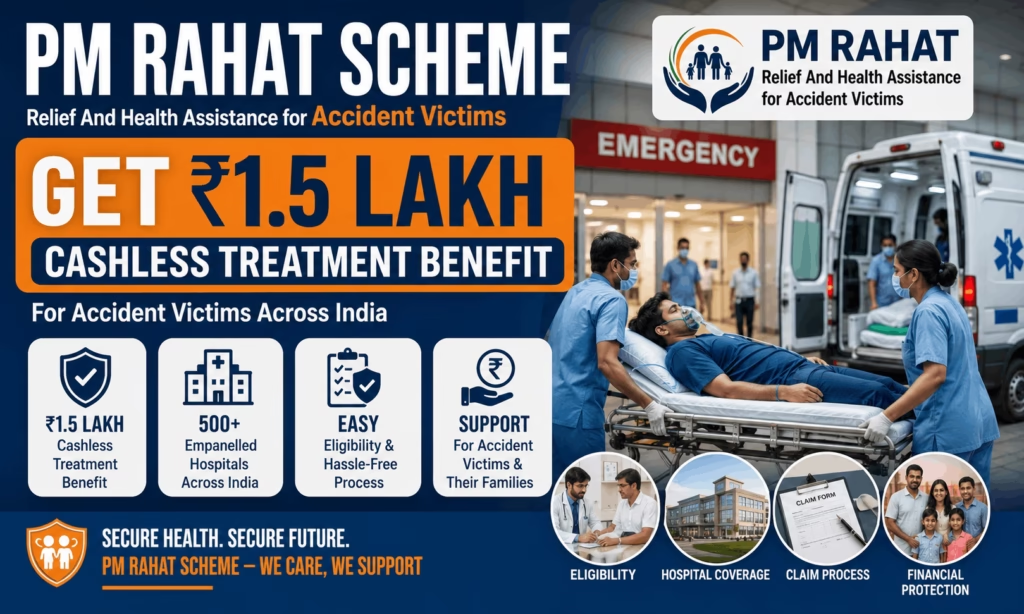
What is the PM RAHAT Scheme?
The PM RAHAT Scheme, formally the Prime Minister, Road Accident Victims’ Hospitalisation and Assured Treatment Scheme, was notified by MoRTH as the Cashless Treatment of Road Accident Victims Scheme on May 5, 2025, with detailed operational guidelines issued on June 4, 2025. It was formally launched by the Prime Minister on February 13, 2026, and officially named via notification S.O. 952(E) dated February 19, 2026.
The scheme’s core objective is to institutionalize “Golden Hour” trauma care, the critical first hour after an accident during which nearly 50% of road accident deaths can be prevented with timely medical intervention. It forms the Emergency Care pillar of India’s 4E road-safety strategy (Education, Engineering, Enforcement, Emergency Care), which aims to reduce road accident fatalities by 50% by 2030.
PM RAHAT Scheme 2026 Key Highlights
| Scheme Name | PM RAHAT (Road Accident Victim Hospitalisation and Assured Treatment) |
| Notified Under | Section 162, Motor Vehicles Act, 1988 |
| Notification Number | S.O. 952(E) dated 19.02.2026 |
| Officially Launched | February 13, 2026, from Seva Teerth, New Delhi |
| Nodal Ministry | Ministry of Road Transport and Highways (MoRTH) |
| Cashless Treatment Cover | Up to ₹1.5 lakh per victim |
| Coverage Duration | Maximum 7 days from date of accident |
| Stabilisation Window | 24 hours (non-life-threatening) / 48 hours (life-threatening) |
| Applicable Roads | All categories — national, state, urban roads |
| Digital Platforms Used | eDAR (Electronic Detailed Accident Report), TMS 2.0 |
| Designated Hospitals | Empanelled under Ayushman Bharat PM-JAY |
| Total Empanelled Hospitals (as of March 9, 2026) | 36,112 hospitals |
| Funding Source | Motor Vehicle Accident Fund (MVAF), insurance company contributions, government budget |
| Claim Settlement Timeline | Within 10 days of approval by State Health Agency |
| Emergency Helpline | 112 (ERSS) |
| Eligibility Scope | All Indian and foreign nationals, insured/uninsured/hit-and-run cases |
Eligibility Criteria for PM RAHAT Scheme 2026
The PM RAHAT Scheme eligibility is designed to be inclusive and does not depend on income, nationality, or insurance status:
- Any person, Indian or foreign national, injured in a road accident caused by a motor vehicle on any category of road is eligible.
- The scheme applies irrespective of whether the vehicle involved was insured, uninsured, or part of a hit-and-run case.
- Victims must be hospitalised within 24 hours of the accident; those admitted after this window are not eligible under the scheme guidelines.
- This is a statutory scheme and takes precedence over any other Central or State-level benefit scheme covering the same purpose.
How PM RAHAT Cashless Treatment Works?
- Emergency Call: The victim or any bystander, referred to as a Rah-Veer (Good Samaritan), can dial 112 (ERSS – Emergency Response Support System) to locate the nearest designated hospital and request an ambulance.
- Hospital Admission: On arrival, the victim is admitted and treatment begins immediately under a predefined Health Benefit Package developed by the National Health Authority (NHA) — with no upfront payment required.
- Treatment ID Generation: The hospital generates a Treatment ID on the TMS 2.0 platform and forwards accident details to the district police through the eDAR system for authentication.
- Police Authentication: Police must verify and authenticate the case within 24 hours for non-life-threatening injuries, or 48 hours for life-threatening situations.
- Claim Approval: The State Health Agency (SHA) reviews and approves the treatment claim based on the digital trail created across eDAR and TMS 2.0.
- Payment to Hospital: Once approved, payment is released within 10 days — through General Insurance companies (if the vehicle was insured) or via the Motor Vehicle Accident Fund (MVAF) for uninsured and hit-and-run cases.
PM RAHAT Hospital Coverage: Which Hospitals Are Designated?
Under the PM RAHAT Scheme hospital list, all hospitals already empanelled under the Ayushman Bharat Pradhan Mantri Jan Arogya Yojana (AB PM-JAY) that meet the additional scheme guidelines are automatically deemed designated hospitals. As of March 9, 2026, a total of 36,112 hospitals across India are empanelled and equipped to provide cashless emergency treatment under this scheme. States and Union Territories are also empowered to onboard additional hospitals as per NHA guidelines issued on May 20, 2025, ensuring wider geographic coverage, especially in areas with high accident rates.
Beneficiaries can also use their ABHA Card (Ayushman Bharat Health Account) wherever applicable to securely share their digital health records during treatment, further streamlining hospital admission and verification.
PM RAHAT Claim Process for Accident Victims
For accident victims and their families, the good news is that the entire claim process is cashless and hospital-managed — victims themselves do not need to file paperwork or pay upfront:
- Treatment begins the moment the victim is admitted, without requiring any bill payment.
- The hospital handles all digital documentation via TMS 2.0, syncing accident details with the eDAR platform.
- Once police authentication and SHA approval are complete, the hospital receives payment directly — the victim is never billed for eligible treatment within the ₹1.5 lakh cap and 7-day window.
- If treatment costs exceed ₹1.5 lakh or continue beyond 7 days, the balance may be covered under separate insurance provisions or the victim’s own resources, depending on the case.
Funding Mechanism: Motor Vehicle Accident Fund (MVAF)
The PM RAHAT Scheme is financially backed by the Motor Vehicle Accident Fund (MVAF), constituted under Section 164B of the Motor Vehicles Act. Funding for insured-vehicle cases comes from contributions by General Insurance companies, while uninsured and hit-and-run cases are financed through Government of India budgetary support. This dual-funding structure ensures hospitals are never left without reimbursement, encouraging uninterrupted treatment regardless of a victim’s insurance status.
Grievance Redressal Mechanism Under PM RAHAT
The scheme includes a multi-tier grievance redressal system to resolve disputes or delays:
- District Level: A Grievance Redressal Officer (GRO) attached to the District Road Safety Committee (DRSC) handles initial complaints.
- Escalation: Unresolved grievances can be escalated to the District Collector and further to the State Road Safety Council (SRSC), the nodal agency for scheme implementation in each state/UT.
- National Oversight: An Inter-Ministerial Steering Committee monitors overall implementation and resolves systemic issues at the national level.
Official Resources and Links for PM RAHAT Scheme
Unlike many welfare schemes, PM RAHAT does not require citizens to register on a separate consumer-facing website — the entire cashless treatment workflow is handled digitally between hospitals, police, and health authorities via eDAR and TMS 2.0. However, the following official resources provide authoritative scheme information and updates:
- Ministry of Road Transport and Highways (Official): morth.nic.in
- National Health Authority (Claims & TMS 2.0 Oversight): nha.gov.in
- Press Information Bureau (Official Notifications & Updates): pib.gov.in
- Emergency Response Helpline (to request ambulance/hospital access): Dial 112
PM RAHAT Scheme Latest Updates
- As of March 9, 2026, hospital empanelment under the scheme stood at 36,112 hospitals nationwide.
- The scheme’s TMS–PFMS integration has been completed and is being deployed in the production environment following an NHA IT final check.
- The government has reiterated that this is a statutory scheme taking precedence over any other central or state benefit scheme for the same purpose, ensuring victims are not denied cover due to overlapping scheme claims.
- The initiative is positioned as the core of India’s “Golden Hour” trauma care strategy, aiming to significantly cut preventable road accident deaths by 2030.
The PM RAHAT Scheme marks a major shift in India’s approach to road safety and emergency healthcare, ensuring that no accident victim is denied life-saving treatment due to financial constraints during the critical Golden Hour. With a growing network of over 36,000 empanelled hospitals, a fully digital claims process through eDAR and TMS 2.0, and a structured grievance redressal mechanism, this scheme provides real, actionable protection for road accident victims across India. If you or someone you know is involved in a road accident, remember that dialling 112 and reaching the nearest designated hospital is the fastest way to access the ₹1.5 lakh cashless treatment benefit under PM RAHAT.
FAQs
PM RAHAT is a central government scheme that provides cashless treatment up to ₹1.5 lakh to road accident victims for up to 7 days from the date of the accident, notified under Section 162 of the Motor Vehicles Act, 1988.
Any person, Indian or foreign national, injured in a road accident on any category of road is eligible, regardless of income, insurance status, or whether it is a hit-and-run case — provided hospitalisation occurs within 24 hours of the accident.
The scheme provides coverage of up to ₹1.5 lakh per victim, capped at a maximum of 7 days from the date of the accident.
Hospitals already empanelled under Ayushman Bharat PM-JAY that meet scheme requirements are automatically designated. As of March 2026, 36,112 hospitals are part of this network.
Dial 112 (ERSS) immediately to request ambulance assistance and locate the nearest designated hospital. Treatment begins on admission without requiring any upfront payment.
Payment is made through the Motor Vehicle Accident Fund (MVAF) — insurance companies pay for insured-vehicle cases, while the government covers uninsured and hit-and-run cases.
The scheme caps cashless coverage at ₹1.5 lakh for 7 days; any additional treatment cost beyond this cap may need to be covered separately, depending on insurance or personal arrangements.
Contact the Grievance Redressal Officer (GRO) under your District Road Safety Committee first; unresolved issues can be escalated to the District Collector and then the State Road Safety Council.